
OSHA 30-Hour General Industry Training
Thirty-hour general industry training for supervisors and safety leads, covering hazard control and employer duties under 29 CFR 1910.
What to Expect
The 30-hour general industry course is written for supervisors, plant managers and safety committee members — anyone whose job includes keeping other people safe. It covers the same 29 CFR 1910 subparts as the 10-hour course but adds the depth a supervisor needs: written programs, exposure limits, inspection routines, permit systems, and the employer obligations that sit behind each standard.
- Standard
- 29 CFR 1910 — General industry standards
- Who it's for
- Supervisors, plant managers, safety committee members and safety leads
- Depth
- Written programs, permit systems, exposure limits and employer duties
- Format
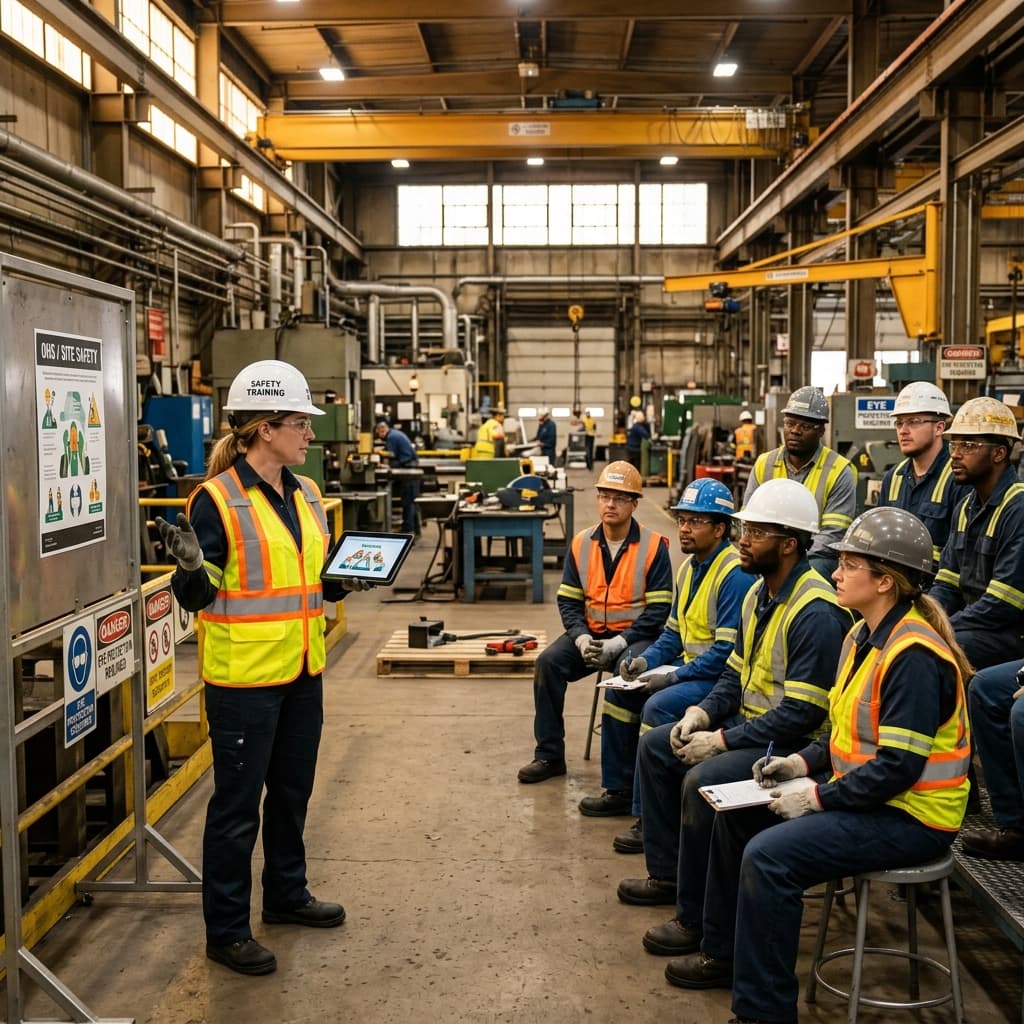
- Delivered onsite at your facility or job site, or by live virtual session with Q&A and documentation.
The programs behind the standards
Most general industry standards require the employer to have something written down — a lockout/tagout program with machine-specific procedures, a hazard communication program, a permit-required confined space program, a respiratory protection program with fit testing. The 30-hour course works through what each of those documents has to contain and who is responsible for keeping them current, which is the part supervisors are usually expected to know and rarely get taught.
Recognising an exposure problem
Permissible exposure limits, action levels and the monitoring that establishes them are a recurring blind spot. The course covers how exposure limits work for noise, air contaminants and substance-specific standards such as respirable crystalline silica, so a supervisor can recognise when a job needs monitoring rather than discovering it during an inspection.
What the course covers
- Managing safety and health programs in general industry
- Lockout/tagout and machine-specific energy control procedures
- Machine guarding, mechanical power presses and safeguarding
- Permit-required confined spaces and entry programs
- Electrical safety, including arc flash awareness
- Hazard communication, chemical safety and written programs
- Respiratory protection, hearing conservation and exposure limits
- Recordkeeping, incident investigation and correcting hazards
- Supervisor-Level Depth
- Written Program Guidance
- Exposure Limit Coverage
- Built on 29 CFR 1910
- Delivered at Your Facility
- Onsite or Virtual Delivery
Trusted Since 2014
Disabled Veteran-Owned Small Business — serving clients nationwide.
Request a Free Consultation
Fill out the form below and we'll be in touch within one business day.
Other courses we deliver
- Workplace Safety TrainingHands-on and classroom safety training to build worker awareness and support OSHA-aligned job performance.
- HAZWOPER TrainingHAZWOPER 40-hour, 24-hour, 8-hour supervisor and annual refresher training for hazardous waste and emergency response work, per 29 CFR 1910.120.
- Confined Space Entry TrainingPermit-required confined space training for entrants, attendants and entry supervisors, built on 29 CFR 1910.146 and 1926 Subpart AA.

What Our Clients Said
- Expert Safety Training
- Customized Safety Programs
- OSHA Compliance Support
- Industrial Hygiene Surveys
- Onsite Safety Inspections
- Written Safety Program Development
“Brad and his team are very helpful and knowledgeable. They came to our job site and conducted safety training that was not only thorough and compliant, but genuinely engaging for our crew. I highly recommend BHG Safety Partners to any company that takes workplace safety seriously.”
OSHA 30-Hour General Industry Questions
We get a lot of the same great questions from new clients. Here are the answers to the ones we hear most often — if yours isn't listed, don't hesitate to reach out directly.
Onsite Safety Training Session